Alice's Adventures in Wonderland: Table of Contents, Links to Chapters, and Synopsis (Lewis Carroll, 1832-1898)

*
1898 Cover of Lewis Carroll's Alice's Adventures in Wonderland
_______________________________________________________


Chapter I: Down the Rabbit Hole

Alice is bored of sitting on the riverbank with her sister, who is reading a book. Suddenly she sees a white rabbit run past wearing a coat and carrying a watch, lamenting running late. She follows it down a rabbit hole and falls very slowly down a tunnel lined with curious objects. She lands in a long hallway lined with locked doors. She finds a little key sitting on a glass table. Behind a curtain on the wall she finds a tiny door that opens with the key and leads into a beautiful garden. The door however is too small for Alice to fit through. Looking back at the table she sees a bottle labelled "DRINK ME" that was not there before. She drinks and it causes her to shrink to a size small enough to fit through the door. Unfortunately Alice has left the key high above on the table. She finds a box under the table in which there is a cake with the words "EAT ME" on it. She eats it, thinking that if it makes her smaller she can creep under the door and if it makes her larger she can get the key.

Chapter II: The Pool of Tears

The cake makes Alice grow so tall that her head hits the ceiling. Getting frustrated, she cries. Her tears flood the hallway. The White Rabbit runs by and is so frightened by Alice that he drops the gloves and fan he is holding. She fans herself with the fan and starts to wonder if she is still the same person that she was before. The fan causes her to shrink again. Alice swims through her own tears and meets a mouse, who is swimming as well. She tries to make small talk with him but all she can think of talking about is her cat, which offends the mouse. The pool becomes crowded with other animals and birds that have been swept away. They all swim to shore.

Chapter III: A Caucus Race and a Long Tale

The first question is how to get dry again. The mouse gives them a very dry lecture on William the Conqueror. A Dodo decides that the best thing to dry them off would be a Caucus-Race. The Dodo marks out a race course in a sort of circle and the racers begin running whenever they feel like it, and everyone wins. Alice reaches into her pocket and finds a box of comfits which she distributes among the winners. The animals then beg the mouse to tell them something more and he recites a tale about a mouse and Fury. Alice mistakes his tale for his tail. This insults him and he leaves. She starts talking about her cat again, which frightens the rest of the animals away.

Chapter IV: The Rabbit Sends in a Little Bill

The White Rabbit appears again and orders Alice to go back to his house and fetch him his gloves and fan. Inside, she finds another bottle and drinks from it. Alice grows so large that she has to stick one arm out the window and her foot up the chimney. The horrified Rabbit orders his gardener, a lizard named Bill, to climb on the roof and go down the chimney. As Bill slides down the chimney Alice kicks him out with her foot, shooting him up into the sky. Outside Alice hears the voices of animals that have gathered to gawk at her giant arm. The crowd hurls pebbles at her, which turn into little cakes that shrink Alice down again. She runs into the woods, where she decides that she must get back to her right size and she must find the lovely garden. Suddenly Alice is confronted by a giant puppy. She picks up a stick and teases him with it until he is tired and she can run away. She comes upon a mushroom and sitting on it is a caterpillar smoking a hookah.

Chapter V: Advice from a Caterpillar

The Caterpillar questions Alice and she admits to her current identity crisis. He asks her to recite "You Are Old, Father William". She does so, but it comes out with many errors. She insults him by saying that three inches is a wretched height to be (he himself is three inches tall). The Caterpillar crawls away into the grass, telling Alice that one side of the mushroom will make her taller and the other side will make her shorter. She breaks off two pieces from the mushroom. One side makes her shrink smaller than ever, while another causes her neck to grow high into the trees, where a pigeon mistakes her for a serpent. With some effort, Alice brings herself back to her usual height. She stumbles upon a small estate and uses the mushroom to reach a more appropriate height.

Chapter VI: Pig and Pepper

A Fish-Footman has an invitation for the Duchess of the house, which he delivers to a Frog-Footman. Alice observes this transaction and, after a perplexing conversation with the frog, welcomes herself into the house. The Duchess' Cook is throwing dishes and making a soup which has too much pepper, which causes Alice, the Duchess and her baby (but not the cook or her grinning Cheshire-Cat) to sneeze violently. The Duchess tosses her baby up and down while reciting the poem "Speak roughly to your little boy." The Duchess gives Alice the baby while she leaves to go play croquet with the Queen. To Alice's surprise, the baby later turns into a pig, so she sets it free in the woods. The Cheshire-Cat appears in a tree, directing her to the March Hare's house. He disappears but his grin remains behind to float on its own in the air.

Chapter VII: A Mad Tea Party

Alice becomes a guest at a mad tea party, along with the Hatter, the March Hare, and the Dormouse. In the course of the party, Alice reveals that the date is May 4 (which happens to be the birthday of her presumed real-life counterpart, Alice Pleasance Liddell). The other characters give Alice many riddles and stories, until she becomes so insulted that she leaves, claiming that it was the stupidest tea party that she had ever been to. Alice comes upon a door in a tree, and enters it, and finds herself back in the long hallway. She opens the door, eats part of her mushroom, and shrinks so she can get into the beautiful garden.

Chapter VIII: The Queen's Croquet Ground

Now in the beautiful garden, she comes upon three living playing cards painting the white roses on a rose tree red because the Queen of Hearts hates white roses. A procession of more cards, kings and queens and even the White Rabbit enters the garden. Alice meets the violent Queen and pacifying King of Hearts. The Queen orders "Off with their heads!" when she sees the work of the gardeners. A game of croquet begins, with flamingos as the mallets and hedgehogs as the balls. The Queen condemns more people to death, and Alice once again meets the Cheshire Cat. The Queen of Hearts then debates chopping off the Cat's head, even though that is all there is of him. Alice suggests talking to the Duchess, so the Queen orders the Duchess out of prison.

Chapter IX: The Mock Turtle's story

The Duchess is brought to the croquet ground. She is now less angry and is always trying to find morals in things. The Queen of Hearts dismisses her on the threat of execution and introduces Alice to the Gryphon, who takes her to the Mock Turtle. The Mock Turtle is very sad, even though he has no sorrow. He tries to tell his story about how he used to be a real turtle in school, which The Gryphon interrupts so they can play a game.

Chapter X: The Lobster Quadrille

The Mock Turtle and the Gryphon dance to the Lobster Quadrille, while Alice recites (rather incorrectly) "Tis the Voice of the Lobster." The Mock Turtle sings them "Beautiful Soup" during which the Gryphon drags Alice away for an impending trial.

Chapter XI: Who Stole the Tarts?

At the trial, the Knave of Hearts is accused of stealing the tarts. The jury box is made up of twelve animals, including Bill the Lizard, and the judge is the King of Hearts. The first witness is the Mad Hatter, who doesn't help the case at all, followed by the Duchess's Cook. During the proceedings, Alice finds that she is steadily growing larger when she is suddenly called as a witness herself.

Chapter XII: Alice's Evidence

Alice accidentally knocks over the jury box as she stands in alarm. She argues with the King and Queen of Hearts over the ridiculous proceedings, eventually refusing to hold her tongue. The Queen shouts her familiar "Off with her head!" but Alice is unafraid, calling them out as just a pack of cards. Alice's sister wakes her up for tea, brushing what turns out to be some leaves and not a shower of playing cards from Alice's face. Alice leaves her sister on the bank to imagine all the curious happenings for herself.

About Alice Liddell Pleasance: Lewis Carroll's Real Alice

_______________________________________

Synopsis from Wikipedia

_______________________________________

Alice Pleasance Liddell (1852-1934): The Real Alice in Wonderland and "A Boat Beneath a Sunny Sky" (Lewis Carroll, 1832-1898)

*
1862 Photograph of seven-year-old Alice Pleasance Liddell (by Charles Dodgson, aka Lewis Carroll)
_________________________________________________________
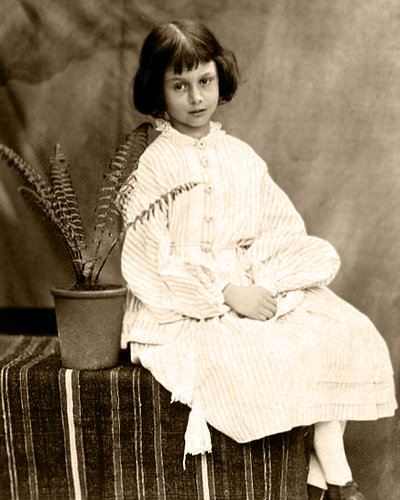
Lewis Carroll (real name Charles Dodgson), author of Alice's Adventures in Wonderland and Through the Looking-Glass, created Alice's Adventures in Wonderland to entertain Alice and her sisters on a boat ride down the Thames. According to Wikipedia:

Alice Pleasance Liddell with her sisters (circa 1859)
__________________________________________________________
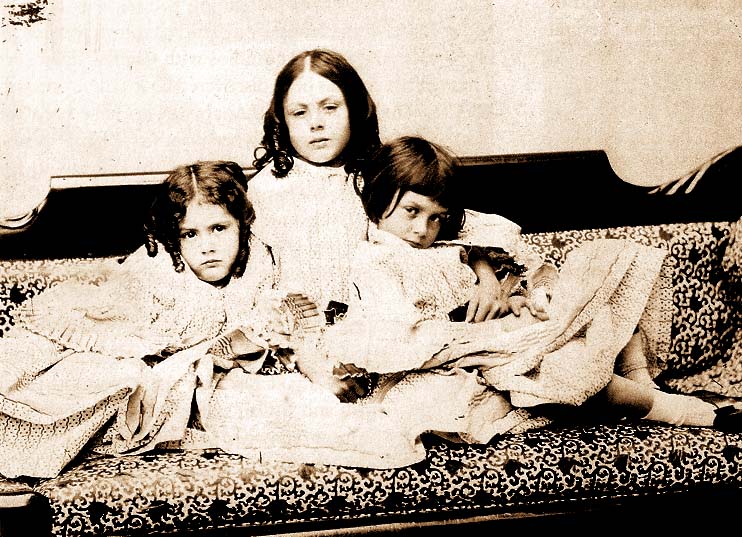
On July 4, 1862, in a rowing boat travelling on The Isis from Folly Bridge, Oxford to Godstow for a picnic outing, 10-year-old Alice asked Charles Dodgson (More commonly known by his pen name, Lewis Carroll) to entertain her and her sisters, Edith (age 8) and Lorina (age 13), with a story. As the Reverend Robinson Duckworth rowed the boat, Dodgson regaled the girls with fantastic stories of a girl, named Alice, and her adventures after she fell into a rabbit-hole. The story was not unlike those Dodgson had spun for the sisters before, but this time Alice asked Mr. Dodgson to write it down for her. He promised to do so but did not get around to the task for some months. He eventually presented Alice with the manuscript of Alice's Adventures Under Ground in November 1864.

In the meantime, Dodgson had decided to rewrite the story as a possible commercial venture. Probably with a view to canvassing his opinion, Dodgson sent the manuscript of Under Ground to a friend, the author George MacDonald, in the spring of 1863 [1]. The MacDonald children read the story and loved it, and this response probably persuaded Dodgson to seek a publisher. Alice's Adventures in Wonderland, with illustrations by John Tenniel, was published in 1865, under the pen name Lewis Carroll. A second "Alice" book, Through the Looking-Glass and What Alice Found There, followed in 1871. In 1886, a facsimile of Alice's Adventures Under Ground, the original manuscript that Dodgson had given Alice, was published.
Carroll wrote an acrostic poem, which appeared in the back of Through the Looking-Glass, about Alice and that fateful trip down the Thames. The first letter in each line spells out "Alice Pleasance Liddell":
A Boat Beneath a Sunny Sky

A boat beneath a sunny sky,
Lingering onward dreamily
In an evening of July--

Children three that nestle near,
Eager eye and willing ear,
Pleased a simple tale to hear--

Long has paled that sunny sky:
Echoes fade and memories die.
Autumn frosts have slain July.

_____________________________________________________________


Alice Pleasance Liddell as a young woman (Photo by Julia Margaret Cameron)
____________________________________________________________


Still she haunts me, phantomwise,
Alice moving under skies
Never seen by waking eyes.

Children yet, the tale to hear,
Eager eye and willing ear,
Lovingly shall nestle near.

In a Wonderland they lie,
Dreaming as the days go by,
Dreaming as the summers die:

Ever drifting down the stream--
Lingering in the golden gleam--
Life, what is it but a dream?

__________________________________________________________
Alice Pleasance Liddell Hargreaves in her older years.
__________________________________________________________

Dreamchild (1985 film)


brechtbug says,

A scene from the Dennis Potter written 1985 film "Dreamchild" based on the book "Alice at 80". Alice Liddell Hargreaves is 80 years old and having flashbacks/hallucinations of her time spent with Reverend Charles Dodgson. The Mad Hatter & March Hare (Jim Henson puppets) are chatting with Coral Browne as elderly Alice & Amelia Shankley young Alice. Elements of "Alice in Wonderland" and "Through the Looking Glass" are combined in this Lewis Carroll inspired film.


*

Chapter XII--Alice's Adventures in Wonderland: "Alice's Evidence" (Lewis Carroll, 1832-1898)

*


'Here!' cried Alice, quite forgetting in the flurry of the moment how large she had grown in the last few minutes, and she jumped up in such a hurry that she tipped over the jury-box with the edge of her skirt, upsetting all the jurymen on to the heads of the crowd below, and there they lay sprawling about, reminding her very much of a globe of goldfish she had accidentally upset the week before.

'Oh, I beg your pardon!' she exclaimed in a tone of great dismay, and began picking them up again as quickly as she could, for the accident of the goldfish kept running in her head, and she had a vague sort of idea that they must be collected at once and put back into the jury-box, or they would die.

'The trial cannot proceed,' said the King in a very grave voice, 'until all the jurymen are back in their proper places-- all,' he repeated with great emphasis, looking hard at Alice as he said do.

Alice looked at the jury-box, and saw that, in her haste, she had put the Lizard in head downwards, and the poor little thing was waving its tail about in a melancholy way, being quite unable to move. She soon got it out again, and put it right; 'not that it signifies much,' she said to herself; 'I should think it would be quite as much use in the trial one way up as the other.'

As soon as the jury had a little recovered from the shock of being upset, and their slates and pencils had been found and handed back to them, they set to work very diligently to write out a history of the accident, all except the Lizard, who seemed too much overcome to do anything but sit with its mouth open, gazing up into the roof of the court.

'What do you know about this business?' the King said to Alice.

'Nothing,' said Alice.

'Nothing whatever?' persisted the King.

'Nothing whatever,' said Alice.

'That's very important,' the King said, turning to the jury. They were just beginning to write this down on their slates, when the White Rabbit interrupted: 'Unimportant, your Majesty means, of course,' he said in a very respectful tone, but frowning and making faces at him as he spoke.

'Unimportant, of course, I meant,' the King hastily said, and went on to himself in an undertone, 'important--unimportant-- unimportant--important--' as if he were trying which word sounded best.

Some of the jury wrote it down 'important,' and some 'unimportant.' Alice could see this, as she was near enough to look over their slates; 'but it doesn't matter a bit,' she thought to herself.

At this moment the King, who had been for some time busily writing in his note-book, cackled out 'Silence!' and read out from his book, 'Rule Forty-two. All persons more than a mile hight to leave the court.'

Everybody looked at Alice.

'I'm not a mile high,' said Alice.

'You are,' said the King.

'Nearly two miles high,' added the Queen.

'Well, I shan't go, at any rate,' said Alice: 'besides, that's not a regular rule: you invented it just now.'

'It's the oldest rule in the book,' said the King.

'Then it ought to be Number One,' said Alice.

The King turned pale, and shut his note-book hastily. 'Consider your verdict,' he said to the jury, in a low, trembling voice.

'There's more evidence to come yet, please your Majesty,' said the White Rabbit, jumping up in a great hurry; 'this paper has just been picked up.'

'What's in it?' said the Queen.

'I haven't opened it yet,' said the White Rabbit, 'but it seems to be a letter, written by the prisoner to--to somebody.'

'It must have been that,' said the King, 'unless it was written to nobody, which isn't usual, you know.'

'Who is it directed to?' said one of the jurymen.

'It isn't directed at all,' said the White Rabbit; 'in fact, there's nothing written on the outside.' He unfolded the paper as he spoke, and added 'It isn't a letter, after all: it's a set of verses.'

'Are they in the prisoner's handwriting?' asked another of they jurymen.

'No, they're not,' said the White Rabbit, 'and that's the queerest thing about it.' (The jury all looked puzzled.)

'He must have imitated somebody else's hand,' said the King. (The jury all brightened up again.)

'Please your Majesty,' said the Knave, 'I didn't write it, and they can't prove I did: there's no name signed at the end.'

'If you didn't sign it,' said the King, 'that only makes the matter worse. You must have meant some mischief, or else you'd have signed your name like an honest man.'

There was a general clapping of hands at this: it was the first really clever thing the King had said that day.

'That proves his guilt,' said the Queen.

'It proves nothing of the sort!' said Alice. 'Why, you don't even know what they're about!'

'Read them,' said the King.

The White Rabbit put on his spectacles. 'Where shall I begin, please your Majesty?' he asked.

'Begin at the beginning,' the King said gravely, 'and go on till you come to the end: then stop.'

These were the verses the White Rabbit read:--

'They told me you had been to her, And mentioned me to him: She gave me a good character, But said I could not swim.

He sent them word I had not gone (We know it to be true): If she should push the matter on, What would become of you?

I gave her one, they gave him two, You gave us three or more; They all returned from him to you, Though they were mine before.

If I or she should chance to be Involved in this affair, He trusts to you to set them free, Exactly as we were.

My notion was that you had been (Before she had this fit) An obstacle that came between Him, and ourselves, and it.

Don't let him know she liked them best, For this must ever be A secret, kept from all the rest, Between yourself and me.'

'That's the most important piece of evidence we've heard yet,' said the King, rubbing his hands; 'so now let the jury--'

'If any one of them can explain it,' said Alice, (she had grown so large in the last few minutes that she wasn't a bit afraid of interrupting him,) 'I'll give him sixpence. _I_ don't believe there's an atom of meaning in it.'

The jury all wrote down on their slates, 'She doesn't believe there's an atom of meaning in it,' but none of them attempted to explain the paper.

'If there's no meaning in it,' said the King, 'that saves a world of trouble, you know, as we needn't try to find any. And yet I don't know,' he went on, spreading out the verses on his knee, and looking at them with one eye; 'I seem to see some meaning in them, after all. "-said I could not swim--" you can't swim, can you?' he added, turning to the Knave.

The Knave shook his head sadly. 'Do I look like it?' he said. (Which he certainly did not, being made entirely of cardboard.)

'All right, so far,' said the King, and he went on muttering over the verses to himself: '"We know it to be true--" that's the jury, of course-- "I gave her one, they gave him two--" why, that must be what he did with the tarts, you know--'

'But, it goes on "they all returned from him to you,"' said Alice.

'Why, there they are!' said the King triumphantly, pointing to the tarts on the table. 'Nothing can be clearer than that. Then again--"before she had this fit--" you never had fits, my dear, I think?' he said to the Queen.

'Never!' said the Queen furiously, throwing an inkstand at the Lizard as she spoke. (The unfortunate little Bill had left off writing on his slate with one finger, as he found it made no mark; but he now hastily began again, using the ink, that was trickling down his face, as long as it lasted.)

'Then the words don't fit you,' said the King, looking round the court with a smile. There was a dead silence.

'It's a pun!' the King added in an offended tone, and everybody laughed, 'Let the jury consider their verdict,' the King said, for about the twentieth time that day.

'No, no!' said the Queen. 'Sentence first--verdict afterwards.'

'Stuff and nonsense!' said Alice loudly. 'The idea of having the sentence first!'

'Hold your tongue!' said the Queen, turning purple.

'I won't!' said Alice.

'Off with her head!' the Queen shouted at the top of her voice. Nobody moved.

'Who cares for you?' said Alice, (she had grown to her full size by this time.) 'You're nothing but a pack of cards!'

At this the whole pack rose up into the air, and came flying down upon her: she gave a little scream, half of fright and half of anger, and tried to beat them off, and found herself lying on the bank, with her head in the lap of her sister, who was gently brushing away some dead leaves that had fluttered down from the trees upon her face.

'Wake up, Alice dear!' said her sister; 'Why, what a long sleep you've had!'

'Oh, I've had such a curious dream!' said Alice, and she told her sister, as well as she could remember them, all these strange Adventures of hers that you have just been reading about; and when she had finished, her sister kissed her, and said, 'It was a curious dream, dear, certainly: but now run in to your tea; it's getting late.' So Alice got up and ran off, thinking while she ran, as well she might, what a wonderful dream it had been.

But her sister sat still just as she left her, leaning her head on her hand, watching the setting sun, and thinking of little Alice and all her wonderful Adventures, till she too began dreaming after a fashion, and this was her dream:--

First, she dreamed of little Alice herself, and once again the tiny hands were clasped upon her knee, and the bright eager eyes were looking up into hers--she could hear the very tones of her voice, and see that queer little toss of her head to keep back the wandering hair that would always get into her eyes--and still as she listened, or seemed to listen, the whole place around her became alive the strange creatures of her little sister's dream.

The long grass rustled at her feet as the White Rabbit hurried by--the frightened Mouse splashed his way through the neighbouring pool--she could hear the rattle of the teacups as the March Hare and his friends shared their never-ending meal, and the shrill voice of the Queen ordering off her unfortunate guests to execution--once more the pig-baby was sneezing on the Duchess's knee, while plates and dishes crashed around it--once more the shriek of the Gryphon, the squeaking of the Lizard's slate-pencil, and the choking of the suppressed guinea-pigs, filled the air, mixed up with the distant sobs of the miserable Mock Turtle.

So she sat on, with closed eyes, and half believed herself in Wonderland, though she knew she had but to open them again, and all would change to dull reality--the grass would be only rustling in the wind, and the pool rippling to the waving of the reeds--the rattling teacups would change to tinkling sheep-bells, and the Queen's shrill cries to the voice of the shepherd boy--and the sneeze of the baby, the shriek of the Gryphon, and all the other queer noises, would change (she knew) to the confused clamour of the busy farm-yard--while the lowing of the cattle in the distance would take the place of the Mock Turtle's heavy sobs.

Lastly, she pictured to herself how this same little sister of hers would, in the after-time, be herself a grown woman; and how she would keep, through all her riper years, the simple and loving heart of her childhood: and how she would gather about her other little children, and make their eyes bright and eager with many a strange tale, perhaps even with the dream of Wonderland of long ago: and how she would feel with all their simple sorrows, and find a pleasure in all their simple joys, remembering her own child-life, and the happy summer days.

___________________________________________________

Illustration: John Tenniel, circa 1865

The King of Hearts.
____________________________________________________


*


Alice's Adventures in Wonderland, originally published 4 July 1865
*

Classic Poetry: The Fairies (William Allingham, 1824? - 1889)--Updated Version

*

___________________________________________________________

Up the airy mountain
---Down the rushy glen,
We daren't go a-hunting,
---For fear of little men;
Wee folk, good folk,
---Trooping all together;
Green jacket, red cap,
---And white owl's feather.
Down along the rocky shore
---Some make their home,
They live on crispy pancakes
---Of yellow tide-foam;
Some in the reeds
---Of the black mountain-lake,
With frogs for their watch-dogs,
---All night awake.

"He's nigh lost his wits."
___________________________________________________________


High on the hill-top
---The old King sits;
He is now so old and gray
---He's nigh lost his wits.
With a bridge of white mist
---Columbkill he crosses,
On his stately journeys
---From Slieveleague to Rosses;
Or going up with music,
---On cold starry nights,
To sup with the Queen,
---Of the gay Northern Lights.

"Her friends were all gone./They took her lightly back."
________________________________________________________________


They stole little Bridget
---For seven years long;
When she came down again
---Her friends were all gone.
They took her lightly back
---Between the night and morrow;
They thought she was fast asleep,
---But she was dead with sorrow.
They have kept her ever since
---Deep within the lake,
On a bed of flag leaves,
---Watching till she wake.

"He shall find the thornies set/In his bed at night."
___________________________________________________________


By the craggy hill-side,
---Through the mosses bare,
They have planted thorn trees
---For pleasure here and there.
Is any man so daring
---As dig them up in spite?
He shall find the thornies set
---In his bed at night.

"We daren't go a-hunting."
_____________________________________________________________


Up the airy mountain
---Down the rushy glen,
We daren't go a-hunting,
---For fear of little men;
Wee folk, good folk,
---Trooping all together;
Green jacket, red cap,
---And white owl's feather.
________________________________________________________________

Spore Demon Fairy


PikminGeneral

________________________________________________________________
*

Chapter XI--Alice's Adventures in Wonderland: "Who Stole the Tarts?" (Lewis Carroll, 1832-1898)

*


The Trial: Who Stole the Tarts?

jdewbre says:
The trial scene the 1983 Great Performances version of "Alice In Wonderland," directed by Kirk Browning and starring Kate Burton as Alice. It's remarkably faithful to the book. My all-time favorite line is Austin Pendleton screaming "HE STOLE THOSE TARTS!"
__________________________________________________


The King and Queen of Hearts were seated on their throne when they arrived, with a great crowd assembled about them--all sorts of little birds and beasts, as well as the whole pack of cards: the Knave was standing before them, in chains, with a soldier on each side to guard him; and near the King was the White Rabbit, with a trumpet in one hand, and a scroll of parchment in the other. In the very middle of the court was a table, with a large dish of tarts upon it: they looked so good, that it made Alice quite hungry to look at them--'I wish they'd get the trial done,' she thought, 'and hand round the refreshments!' But there seemed to be no chance of this, so she began looking at everything about her, to pass away the time.

Alice had never been in a court of justice before, but she had read about them in books, and she was quite pleased to find that she knew the name of nearly everything there. 'That's the judge,' she said to herself, 'because of his great wig.'

The judge, by the way, was the King; and as he wore his crown over the wig, (look at the frontispiece if you want to see how he did it,) he did not look at all comfortable, and it was certainly not becoming.

'And that's the jury-box,' thought Alice, 'and those twelve creatures,' (she was obliged to say 'creatures,' you see, because some of them were animals, and some were birds,) 'I suppose they are the jurors.' She said this last word two or three times over to herself, being rather proud of it: for she thought, and rightly too, that very few little girls of her age knew the meaning of it at all. However, 'jury-men' would have done just as well.

The twelve jurors were all writing very busily on slates. 'What are they doing?' Alice whispered to the Gryphon. 'They can't have anything to put down yet, before the trial's begun.'

'They're putting down their names,' the Gryphon whispered in reply, 'for fear they should forget them before the end of the trial.'

'Stupid things!' Alice began in a loud, indignant voice, but she stopped hastily, for the White Rabbit cried out, 'Silence in the court!' and the King put on his spectacles and looked anxiously round, to make out who was talking.

Alice could see, as well as if she were looking over their shoulders, that all the jurors were writing down 'stupid things!' on their slates, and she could even make out that one of them didn't know how to spell 'stupid,' and that he had to ask his neighbour to tell him. 'A nice muddle their slates'll be in before the trial's over!' thought Alice.

One of the jurors had a pencil that squeaked. This of course, Alice could not stand, and she went round the court and got behind him, and very soon found an opportunity of taking it away. She did it so quickly that the poor little juror (it was Bill, the Lizard) could not make out at all what had become of it; so, after hunting all about for it, he was obliged to write with one finger for the rest of the day; and this was of very little use, as it left no mark on the slate.

'Herald, read the accusation!' said the King.

On this the White Rabbit blew three blasts on the trumpet, and then unrolled the parchment scroll, and read as follows:--

'The Queen of Hearts, she made some tarts, All on a summer day: The Knave of Hearts, he stole those tarts, And took them quite away!'

'Consider your verdict,' the King said to the jury.

'Not yet, not yet!' the Rabbit hastily interrupted. 'There's a great deal to come before that!'

'Call the first witness,' said the King; and the White Rabbit blew three blasts on the trumpet, and called out, 'First witness!'

The first witness was the Hatter. He came in with a teacup in one hand and a piece of bread-and-butter in the other. 'I beg pardon, your Majesty,' he began, 'for bringing these in: but I hadn't quite finished my tea when I was sent for.'

'You ought to have finished,' said the King. 'When did you begin?'

The Hatter looked at the March Hare, who had followed him into the court, arm-in-arm with the Dormouse. 'Fourteenth of March, I think it was,' he said.

'Fifteenth,' said the March Hare.

'Sixteenth,' added the Dormouse.

'Write that down,' the King said to the jury, and the jury eagerly wrote down all three dates on their slates, and then added them up, and reduced the answer to shillings and pence.

'Take off your hat,' the King said to the Hatter.

'It isn't mine,' said the Hatter.

'Stolen!' the King exclaimed, turning to the jury, who instantly made a memorandum of the fact.

'I keep them to sell,' the Hatter added as an explanation; 'I've none of my own. I'm a hatter.'

Here the Queen put on her spectacles, and began staring at the Hatter, who turned pale and fidgeted.

'Give your evidence,' said the King; 'and don't be nervous, or I'll have you executed on the spot.'

This did not seem to encourage the witness at all: he kept shifting from one foot to the other, looking uneasily at the Queen, and in his confusion he bit a large piece out of his teacup instead of the bread-and-butter.

Just at this moment Alice felt a very curious sensation, which puzzled her a good deal until she made out what it was: she was beginning to grow larger again, and she thought at first she would get up and leave the court; but on second thoughts she decided to remain where she was as long as there was room for her.

'I wish you wouldn't squeeze so.' said the Dormouse, who was sitting next to her. 'I can hardly breathe.'

'I can't help it,' said Alice very meekly: 'I'm growing.'

'You've no right to grow here,' said the Dormouse.

'Don't talk nonsense,' said Alice more boldly: 'you know you're growing too.'

'Yes, but I grow at a reasonable pace,' said the Dormouse: 'not in that ridiculous fashion.' And he got up very sulkily and crossed over to the other side of the court.

All this time the Queen had never left off staring at the Hatter, and, just as the Dormouse crossed the court, she said to one of the officers of the court, 'Bring me the list of the singers in the last concert!' on which the wretched Hatter trembled so, that he shook both his shoes off.

'Give your evidence,' the King repeated angrily, 'or I'll have you executed, whether you're nervous or not.'

'I'm a poor man, your Majesty,' the Hatter began, in a trembling voice, '--and I hadn't begun my tea--not above a week or so--and what with the bread-and-butter getting so thin--and the twinkling of the tea--'

'The twinkling of the what?' said the King.

'It began with the tea,' the Hatter replied.

'Of course twinkling begins with a T!' said the King sharply. 'Do you take me for a dunce? Go on!'

'I'm a poor man,' the Hatter went on, 'and most things twinkled after that--only the March Hare said--'

'I didn't!' the March Hare interrupted in a great hurry.

'You did!' said the Hatter.

'I deny it!' said the March Hare.

'He denies it,' said the King: 'leave out that part.'

'Well, at any rate, the Dormouse said--' the Hatter went on, looking anxiously round to see if he would deny it too: but the Dormouse denied nothing, being fast asleep.

'After that,' continued the Hatter, 'I cut some more bread- and-butter--'

'But what did the Dormouse say?' one of the jury asked.

'That I can't remember,' said the Hatter.

'You must remember,' remarked the King, 'or I'll have you executed.'

The miserable Hatter dropped his teacup and bread-and-butter, and went down on one knee. 'I'm a poor man, your Majesty,' he began.

'You're a very poor speaker,' said the King.

Here one of the guinea-pigs cheered, and was immediately suppressed by the officers of the court. (As that is rather a hard word, I will just explain to you how it was done. They had a large canvas bag, which tied up at the mouth with strings: into this they slipped the guinea-pig, head first, and then sat upon it.)

'I'm glad I've seen that done,' thought Alice. 'I've so often read in the newspapers, at the end of trials, "There was some attempts at applause, which was immediately suppressed by the officers of the court," and I never understood what it meant till now.'

'If that's all you know about it, you may stand down,' continued the King.

'I can't go no lower,' said the Hatter: 'I'm on the floor, as it is.'

'Then you may sit down,' the King replied.

Here the other guinea-pig cheered, and was suppressed.

'Come, that finished the guinea-pigs!' thought Alice. 'Now we shall get on better.'

'I'd rather finish my tea,' said the Hatter, with an anxious look at the Queen, who was reading the list of singers.

'You may go,' said the King, and the Hatter hurriedly left the court, without even waiting to put his shoes on.

'--and just take his head off outside,' the Queen added to one of the officers: but the Hatter was out of sight before the officer could get to the door.

'Call the next witness!' said the King.

The next witness was the Duchess's cook. She carried the pepper-box in her hand, and Alice guessed who it was, even before she got into the court, by the way the people near the door began sneezing all at once.

'Give your evidence,' said the King.

'Shan't,' said the cook.

The King looked anxiously at the White Rabbit, who said in a low voice, 'Your Majesty must cross-examine this witness.'

'Well, if I must, I must,' the King said, with a melancholy air, and, after folding his arms and frowning at the cook till his eyes were nearly out of sight, he said in a deep voice, 'What are tarts made of?'

'Pepper, mostly,' said the cook.

'Treacle,' said a sleepy voice behind her.

'Collar that Dormouse,' the Queen shrieked out. 'Behead that Dormouse! Turn that Dormouse out of court! Suppress him! Pinch him! Off with his whiskers!'

For some minutes the whole court was in confusion, getting the Dormouse turned out, and, by the time they had settled down again, the cook had disappeared.

'Never mind!' said the King, with an air of great relief. 'Call the next witness.' And he added in an undertone to the Queen, 'Really, my dear, you must cross-examine the next witness. It quite makes my forehead ache!'

Alice watched the White Rabbit as he fumbled over the list, feeling very curious to see what the next witness would be like, '--for they haven't got much evidence yet,' she said to herself. Imagine her surprise, when the White Rabbit read out, at the top of his shrill little voice, the name 'Alice!'

____________________________________________________

Illustration: John Tenniel, circa 1865

The King and Queen of Hearts.
____________________________________________________

*

Alice's Adventures in Wonderland, originally published 4 July 1865
*

Chapter X--Alice's Adventures in Wonderland: "The Lobster Quadrille" (Lewis Carroll, 1832-1898)

*


jdewbre

"Meryl Streep meets the Mock Turtle and dances the Lobster Quadrille in the New York Shakespeare Festival production of Elizabeth Swados' 'Alice At The Palace' (1981)."
____________________________________________________________
The Mock Turtle sighed deeply, and drew the back of one flapper across his eyes. He looked at Alice, and tried to speak, but for a minute or two sobs choked his voice. 'Same as if he had a bone in his throat,' said the Gryphon: and it set to work shaking him and punching him in the back. At last the Mock Turtle recovered his voice, and, with tears running down his cheeks, he went on again:--

'You may not have lived much under the sea--' ('I haven't,' said Alice)-- 'and perhaps you were never even introduced to a lobster--' (Alice began to say 'I once tasted--' but checked herself hastily, and said 'No, never') '--so you can have no idea what a delightful thing a Lobster Quadrille is!'

'No, indeed,' said Alice. 'What sort of a dance is it?'

'Why,' said the Gryphon, 'you first form into a line along the sea-shore--'

'Two lines!' cried the Mock Turtle. 'Seals, turtles, salmon, and so on; then, when you've cleared all the jelly-fish out of the way--'

'That generally takes some time,' interrupted the Gryphon.

'--you advance twice--'

'Each with a lobster as a partner!' cried the Gryphon.


'Of course,' the Mock Turtle said: 'advance twice, set to partners--'

'--change lobsters, and retire in same order,' continued the Gryphon.

'Then, you know,' the Mock Turtle went on, 'you throw the--'

'The lobsters!' shouted the Gryphon, with a bound into the air.

'--as far out to sea as you can--'

'Swim after them!' screamed the Gryphon.

'Turn a somersault in the sea!' cried the Mock Turtle, capering wildly about.

'Change lobster's again!' yelled the Gryphon at the top of its voice.

'Back to land again, and that's all the first figure,' said the Mock Turtle, suddenly dropping his voice; and the two creatures, who had been jumping about like mad things all this time, sat down again very sadly and quietly, and looked at Alice.

'It must be a very pretty dance,' said Alice timidly.

'Would you like to see a little of it?' said the Mock Turtle.

'Very much indeed,' said Alice.

'Come, let's try the first figure!' said the Mock Turtle to the Gryphon. 'We can do without lobsters, you know. Which shall sing?'

'Oh, you sing,' said the Gryphon. 'I've forgotten the words.'

So they began solemnly dancing round and round Alice, every now and then treading on her toes when they passed too close, and waving their forepaws to mark the time, while the Mock Turtle sang this, very slowly and sadly:--

'"Will you walk a little faster?" said a whiting to a snail. "There's a porpoise close behind us, and he's treading on my tail. See how eagerly the lobsters and the turtles all advance! They are waiting on the shingle--will you come and join the dance?

Will you, won't you, will you, won't you, will you join the dance? Will you, won't you, will you, won't you, won't you join the dance?

"You can really have no notion how delightful it will be When they take us up and throw us, with the lobsters, out to sea!" But the snail replied "Too far, too far!" and gave a look askance-- Said he thanked the whiting kindly, but he would not join the dance. Would not, could not, would not, could not, would not join the dance. Would not, could not, would not, could not, could not join the dance.

'"What matters it how far we go?" his scaly friend replied. "There is another shore, you know, upon the other side. The further off from England the nearer is to France-- Then turn not pale, beloved snail, but come and join the dance.

Will you, won't you, will you, won't you, will you join the dance? Will you, won't you, will you, won't you, won't you join the dance?"'


'Thank you, it's a very interesting dance to watch,' said Alice, feeling very glad that it was over at last: 'and I do so like that curious song about the whiting!'

'Oh, as to the whiting,' said the Mock Turtle, 'they--you've seen them, of course?'

'Yes,' said Alice, 'I've often seen them at dinn--' she checked herself hastily.

'I don't know where Dinn may be,' said the Mock Turtle, 'but if you've seen them so often, of course you know what they're like.'

'I believe so,' Alice replied thoughtfully. 'They have their tails in their mouths--and they're all over crumbs.'

'You're wrong about the crumbs,' said the Mock Turtle: 'crumbs would all wash off in the sea. But they have their tails in their mouths; and the reason is--' here the Mock Turtle yawned and shut his eyes.--'Tell her about the reason and all that,' he said to the Gryphon.

'The reason is,' said the Gryphon, 'that they would go with the lobsters to the dance. So they got thrown out to sea. So they had to fall a long way. So they got their tails fast in their mouths. So they couldn't get them out again. That's all.'

'Thank you,' said Alice, 'it's very interesting. I never knew so much about a whiting before.'

'I can tell you more than that, if you like,' said the Gryphon. 'Do you know why it's called a whiting?'

'I never thought about it,' said Alice. 'Why?'

'It does the boots and shoes.' the Gryphon replied very solemnly.

Alice was thoroughly puzzled. 'Does the boots and shoes!' she repeated in a wondering tone.

'Why, what are your shoes done with?' said the Gryphon. 'I mean, what makes them so shiny?'

Alice looked down at them, and considered a little before she gave her answer. 'They're done with blacking, I believe.'

'Boots and shoes under the sea,' the Gryphon went on in a deep voice, 'are done with a whiting. Now you know.'

'And what are they made of?' Alice asked in a tone of great curiosity.

'Soles and eels, of course,' the Gryphon replied rather impatiently: 'any shrimp could have told you that.'

'If I'd been the whiting,' said Alice, whose thoughts were still running on the song, 'I'd have said to the porpoise, "Keep back, please: we don't want you with us!"'

'They were obliged to have him with them,' the Mock Turtle said: 'no wise fish would go anywhere without a porpoise.'

'Wouldn't it really?' said Alice in a tone of great surprise.

'Of course not,' said the Mock Turtle: 'why, if a fish came to me, and told me he was going a journey, I should say "With what porpoise?"'

'Don't you mean "purpose"?' said Alice.

'I mean what I say,' the Mock Turtle replied in an offended tone. And the Gryphon added 'Come, let's hear some of your adventures.'

'I could tell you my adventures--beginning from this morning,' said Alice a little timidly: 'but it's no use going back to yesterday, because I was a different person then.'

'Explain all that,' said the Mock Turtle.

'No, no! The adventures first,' said the Gryphon in an impatient tone: 'explanations take such a dreadful time.'

So Alice began telling them her adventures from the time when she first saw the White Rabbit. She was a little nervous about it just at first, the two creatures got so close to her, one on each side, and opened their eyes and mouths so very wide, but she gained courage as she went on. Her listeners were perfectly quiet till she got to the part about her repeating 'You are old, Father William,' to the Caterpillar, and the words all coming different, and then the Mock Turtle drew a long breath, and said 'That's very curious.'

'It's all about as curious as it can be,' said the Gryphon.

'It all came different!' the Mock Turtle repeated thoughtfully. 'I should like to hear her try and repeat something now. Tell her to begin.' He looked at the Gryphon as if he thought it had some kind of authority over Alice.

'Stand up and repeat "'Tis the voice of the sluggard,"' said the Gryphon.

'How the creatures order one about, and make one repeat lessons!' thought Alice; 'I might as well be at school at once.' However, she got up, and began to repeat it, but her head was so full of the Lobster Quadrille, that she hardly knew what she was saying, and the words came very queer indeed:--

''Tis the voice of the Lobster; I heard him declare, "You have baked me too brown, I must sugar my hair." As a duck with its eyelids, so he with his nose Trims his belt and his buttons, and turns out his toes.'

[later editions continued as follows "When the sands are all dry, he is gay as a lark, And will talk in contemptuous tones of the Shark, But, when the tide rises and sharks are around, His voice has a timid and tremulous sound."]

'That's different from what I used to say when I was a child,' said the Gryphon.

'Well, I never heard it before,' said the Mock Turtle; 'but it sounds uncommon nonsense.'

Alice said nothing; she had sat down with her face in her hands, wondering if anything would ever happen in a natural way again.

'I should like to have it explained,' said the Mock Turtle.

'She can't explain it,' said the Gryphon hastily. 'Go on with the next verse.'

'But about his toes?' the Mock Turtle persisted. 'How could he turn them out with his nose, you know?'

'It's the first position in dancing.' Alice said; but was dreadfully puzzled by the whole thing, and longed to change the subject.

'Go on with the next verse,' the Gryphon repeated impatiently: 'it begins "I passed by his garden."'

Alice did not dare to disobey, though she felt sure it would all come wrong, and she went on in a trembling voice:--

'I passed by his garden, and marked, with one eye, How the Owl and the Panther were sharing a pie--'

[later editions continued as follows: "The Panther took pie-crust, and gravy, and meat, While the Owl had the dish as its share of the treat. When the pie was all finished, the Owl, as a boon, Was kindly permitted to pocket the spoon: While the Panther received knife and fork with a growl, And concluded the banquet--"]

'What is the use of repeating all that stuff,' the Mock Turtle interrupted, 'if you don't explain it as you go on? It's by far the most confusing thing I ever heard!'

'Yes, I think you'd better leave off,' said the Gryphon: and Alice was only too glad to do so.

'Shall we try another figure of the Lobster Quadrille?' the Gryphon went on. 'Or would you like the Mock Turtle to sing you a song?'

'Oh, a song, please, if the Mock Turtle would be so kind,' Alice replied, so eagerly that the Gryphon said, in a rather offended tone, 'Hm! No accounting for tastes! Sing her "Turtle Soup," will you, old fellow?'

The Mock Turtle sighed deeply, and began, in a voice sometimes choked with sobs, to sing this:--

'Beautiful Soup, so rich and green, Waiting in a hot tureen! Who for such dainties would not stoop? Soup of the evening, beautiful Soup! Soup of the evening, beautiful Soup! Beau--ootiful Soo--oop! Beau--ootiful Soo--oop! Soo--oop of the e--e--evening, Beautiful, beautiful Soup!

'Beautiful Soup! Who cares for fish, Game, or any other dish? Who would not give all else for two pennyworth only of beautiful Soup? Pennyworth only of beautiful Soup? Beau--ootiful Soo--oop! Beau--ootiful Soo--oop! Soo--oop of the e--e--evening, Beautiful, beauti--FUL SOUP!'


'Chorus again!' cried the Gryphon, and the Mock Turtle had just begun to repeat it, when a cry of 'The trial's beginning!' was heard in the distance.

'Come on!' cried the Gryphon, and, taking Alice by the hand, it hurried off, without waiting for the end of the song.

'What trial is it?' Alice panted as she ran; but the Gryphon only answered 'Come on!' and ran the faster, while more and more faintly came, carried on the breeze that followed them, the melancholy words:--

'Soo--oop of the e--e--evening, Beautiful, beautiful Soup!'

____________________________________________________

Illustration: John Tenniel, circa 1865

The Lobster.
____________________________________________________


*

Alice's Adventures in Wonderland, originally published 4 July 1865
*

Claasic Fiction: "The Tell-Tale Heart" (Edgar Allan Poe, 1809-1849)

.

TRUE! nervous, very, very dreadfully nervous I had been and am; but why WILL you say that I am mad? The disease had sharpened my senses, not destroyed, not dulled them. Above all was the sense of hearing acute. I heard all things in the heaven and in the earth. I heard many things in hell. How then am I mad? Hearken! and observe how healthily, how calmly, I can tell you the whole story.

It is impossible to say how first the idea entered my brain, but, once conceived, it haunted me day and night. Object there was none. Passion there was none. I loved the old man. He had never wronged me. He had never given me insult. For his gold I had no desire. I think it was his eye! Yes, it was this! One of his eyes resembled that of a vulture -- a pale blue eye with a film over it. Whenever it fell upon me my blood ran cold, and so by degrees, very gradually, I made up my mind to take the life of the old man, and thus rid myself of the eye for ever.

Now this is the point. You fancy me mad. Madmen know nothing. But you should have seen me. You should have seen how wisely I proceeded -- with what caution -- with what foresight, with what dissimulation, I went to work! I was never kinder to the old man than during the whole week before I killed him. And every night about midnight I turned the latch of his door and opened it oh, so gently! And then, when I had made an opening sufficient for my head, I put in a dark lantern all closed, closed so that no light shone out, and then I thrust in my head. Oh, you would have laughed to see how cunningly I thrust it in! I moved it slowly, very, very slowly, so that I might not disturb the old man's sleep. It took me an hour to place my whole head within the opening so far that I could see him as he lay upon his bed. Ha! would a madman have been so wise as this? And then when my head was well in the room I undid the lantern cautiously -- oh, so cautiously -- cautiously (for the hinges creaked), I undid it just so much that a single thin ray fell upon the vulture eye. And this I did for seven long nights, every night just at midnight, but I found the eye always closed, and so it was impossible to do the work, for it was not the old man who vexed me but his Evil Eye. And every morning, when the day broke, I went boldly into the chamber and spoke courageously to him, calling him by name in a hearty tone, and inquiring how he had passed the night. So you see he would have been a very profound old man, indeed , to suspect that every night, just at twelve, I looked in upon him while he slept.

Upon the eighth night I was more than usually cautious in opening the door. A watch's minute hand moves more quickly than did mine. Never before that night had I felt the extent of my own powers, of my sagacity. I could scarcely contain my feelings of triumph. To think that there I was opening the door little by little, and he not even to dream of my secret deeds or thoughts. I fairly chuckled at the idea, and perhaps he heard me, for he moved on the bed suddenly as if startled. Now you may think that I drew back -- but no. His room was as black as pitch with the thick darkness (for the shutters were close fastened through fear of robbers), and so I knew that he could not see the opening of the door, and I kept pushing it on steadily, steadily.

I had my head in, and was about to open the lantern, when my thumb slipped upon the tin fastening , and the old man sprang up in the bed, crying out, "Who's there?"

I kept quite still and said nothing. For a whole hour I did not move a muscle, and in the meantime I did not hear him lie down. He was still sitting up in the bed, listening; just as I have done night after night hearkening to the death watches in the wall.

Presently, I heard a slight groan, and I knew it was the groan of mortal terror. It was not a groan of pain or of grief -- oh, no! It was the low stifled sound that arises from the bottom of the soul when overcharged with awe. I knew the sound well. Many a night, just at midnight, when all the world slept, it has welled up from my own bosom, deepening, with its dreadful echo, the terrors that distracted me. I say I knew it well. I knew what the old man felt, and pitied him although I chuckled at heart. I knew that he had been lying awake ever since the first slight noise when he had turned in the bed. His fears had been ever since growing upon him. He had been trying to fancy them causeless, but could not. He had been saying to himself, "It is nothing but the wind in the chimney, it is only a mouse crossing the floor," or, "It is merely a cricket which has made a single chirp." Yes he has been trying to comfort himself with these suppositions ; but he had found all in vain. ALL IN VAIN, because Death in approaching him had stalked with his black shadow before him and enveloped the victim. And it was the mournful influence of the unperceived shadow that caused him to feel, although he neither saw nor heard, to feel the presence of my head within the room.

When I had waited a long time very patiently without hearing him lie down, I resolved to open a little -- a very, very little crevice in the lantern. So I opened it -- you cannot imagine how stealthily, stealthily -- until at length a single dim ray like the thread of the spider shot out from the crevice and fell upon the vulture eye.

It was open, wide, wide open, and I grew furious as I gazed upon it. I saw it with perfect distinctness -- all a dull blue with a hideous veil over it that chilled the very marrow in my bones, but I could see nothing else of the old man's face or person, for I had directed the ray as if by instinct precisely upon the damned spot.

And now have I not told you that what you mistake for madness is but over-acuteness of the senses? now, I say, there came to my ears a low, dull, quick sound, such as a watch makes when enveloped in cotton. I knew that sound well too. It was the beating of the old man's heart. It increased my fury as the beating of a drum stimulates the soldier into courage.

But even yet I refrained and kept still. I scarcely breathed. I held the lantern motionless. I tried how steadily I could maintain the ray upon the eye. Meantime the hellish tattoo of the heart increased. It grew quicker and quicker, and louder and louder, every instant. The old man's terror must have been extreme! It grew louder, I say, louder every moment! -- do you mark me well? I have told you that I am nervous: so I am. And now at the dead hour of the night, amid the dreadful silence of that old house, so strange a noise as this excited me to uncontrollable terror. Yet, for some minutes longer I refrained and stood still. But the beating grew louder, louder! I thought the heart must burst. And now a new anxiety seized me -- the sound would be heard by a neighbour! The old man's hour had come! With a loud yell, I threw open the lantern and leaped into the room. He shrieked once -- once only. In an instant I dragged him to the floor, and pulled the heavy bed over him. I then smiled gaily, to find the deed so far done. But for many minutes the heart beat on with a muffled sound. This, however, did not vex me; it would not be heard through the wall. At length it ceased. The old man was dead. I removed the bed and examined the corpse. Yes, he was stone, stone dead. I placed my hand upon the heart and held it there many minutes. There was no pulsation. He was stone dead. His eye would trouble me no more.

If still you think me mad, you will think so no longer when I describe the wise precautions I took for the concealment of the body. The night waned, and I worked hastily, but in silence.

I took up three planks from the flooring of the chamber, and deposited all between the scantlings. I then replaced the boards so cleverly so cunningly, that no human eye -- not even his -- could have detected anything wrong. There was nothing to wash out -- no stain of any kind -- no blood-spot whatever. I had been too wary for that.

When I had made an end of these labours, it was four o'clock -- still dark as midnight. As the bell sounded the hour, there came a knocking at the street door. I went down to open it with a light heart, -- for what had I now to fear? There entered three men, who introduced themselves, with perfect suavity, as officers of the police. A shriek had been heard by a neighbour during the night; suspicion of foul play had been aroused; information had been lodged at the police office, and they (the officers) had been deputed to search the premises.

I smiled, -- for what had I to fear? I bade the gentlemen welcome. The shriek, I said, was my own in a dream. The old man, I mentioned, was absent in the country. I took my visitors all over the house. I bade them search -- search well. I led them, at length, to his chamber. I showed them his treasures, secure, undisturbed. In the enthusiasm of my confidence, I brought chairs into the room, and desired them here to rest from their fatigues, while I myself, in the wild audacity of my perfect triumph, placed my own seat upon the very spot beneath which reposed the corpse of the victim.

The officers were satisfied. My MANNER had convinced them. I was singularly at ease. They sat and while I answered cheerily, they chatted of familiar things. But, ere long, I felt myself getting pale and wished them gone. My head ached, and I fancied a ringing in my ears; but still they sat, and still chatted. The ringing became more distinct : I talked more freely to get rid of the feeling: but it continued and gained definitiveness -- until, at length, I found that the noise was NOT within my ears.

No doubt I now grew VERY pale; but I talked more fluently, and with a heightened voice. Yet the sound increased -- and what could I do? It was A LOW, DULL, QUICK SOUND -- MUCH SUCH A SOUND AS A WATCH MAKES WHEN ENVELOPED IN COTTON. I gasped for breath, and yet the officers heard it not. I talked more quickly, more vehemently but the noise steadily increased. I arose and argued about trifles, in a high key and with violent gesticulations; but the noise steadily increased. Why WOULD they not be gone? I paced the floor to and fro with heavy strides, as if excited to fury by the observations of the men, but the noise steadily increased. O God! what COULD I do? I foamed -- I raved -- I swore! I swung the chair upon which I had been sitting, and grated it upon the boards, but the noise arose over all and continually increased. It grew louder -- louder -- louder! And still the men chatted pleasantly , and smiled. Was it possible they heard not? Almighty God! -- no, no? They heard! -- they suspected! -- they KNEW! -- they were making a mockery of my horror! -- this I thought, and this I think. But anything was better than this agony! Anything was more tolerable than this derision! I could bear those hypocritical smiles no longer! I felt that I must scream or die! -- and now -- again -- hark! louder! louder! louder! LOUDER! --

"Villains!" I shrieked, "dissemble no more! I admit the deed! -- tear up the planks! -- here, here! -- it is the beating of his hideous heart!"
(1843)


__________________________________________________________________

Animated Version of "The Tell-Tale Heart," Edgar Allan Poe (Columbia Pictures)


jmcusack
__________________________________________________________________

*

Chapter IX--Alice's Adventures in Wonderland: "The Mock Turtle's Story" (Lewis Carroll, 1832-1898)

*


'You can't think how glad I am to see you again, you dear old thing!' said the Duchess, as she tucked her arm affectionately into Alice's, and they walked off together.

Alice was very glad to find her in such a pleasant temper, and thought to herself that perhaps it was only the pepper that had made her so savage when they met in the kitchen.

'When
I'm a Duchess,' she said to herself, (not in a very hopeful tone though), 'I won't have any pepper in my kitchen at all. Soup does very well without--Maybe it's always pepper that makes people hot-tempered,' she went on, very much pleased at having found out a new kind of rule, 'and vinegar that makes them sour--and camomile that makes them bitter--and--and barley-sugar and such things that make children sweet-tempered. I only wish people knew that: then they wouldn't be so stingy about it, you know--'

She had quite forgotten the Duchess by this time, and was a little startled when she heard her voice close to her ear. 'You're thinking about something, my dear, and that makes you forget to talk. I can't tell you just now what the moral of that is, but I shall remember it in a bit.'

'Perhaps it hasn't one,' Alice ventured to remark.

'Tut, tut, child!' said the Duchess. 'Everything's got a moral, if only you can find it.' And she squeezed herself up closer to Alice's side as she spoke.

Alice did not much like keeping so close to her: first, because the Duchess was
very ugly; and secondly, because she was exactly the right height to rest her chin upon Alice's shoulder, and it was an uncomfortably sharp chin. However, she did not like to be rude, so she bore it as well as she could.

'The game's going on rather better now,' she said, by way of keeping up the conversation a little.

''Tis so,' said the Duchess: 'and the moral of that is--"Oh, 'tis love, 'tis love, that makes the world go round!"'

'Somebody said,' Alice whispered, 'that it's done by everybody minding their own business!'

'Ah, well! It means much the same thing,' said the Duchess, digging her sharp little chin into Alice's shoulder as she added, 'and the moral of that is--"Take care of the sense, and the sounds will take care of themselves."'

'How fond she is of finding morals in things!' Alice thought to herself.

'I dare say you're wondering why I don't put my arm round your waist,' the Duchess said after a pause: 'the reason is, that I'm doubtful about the temper of your flamingo. Shall I try the experiment?'

'He might bite,' Alice cautiously replied, not feeling at all anxious to have the experiment tried.

'Very true,' said the Duchess: 'flamingoes and mustard both bite. And the moral of
that is--"Birds of a feather flock together."'

'Only mustard isn't a bird,' Alice remarked.

'Right, as usual,' said the Duchess: 'what a clear way you have of putting things!'

'It's a mineral, I
think,' said Alice.

'Of course it is,' said the Duchess, who seemed ready to agree to everything that Alice said; 'there's a large mustard-mine near here. And the moral of that is--"The more there is of mine, the less there is of yours."'

'Oh, I know!' exclaimed Alice, who had not attended to this last remark, 'it's a vegetable. It doesn't look like one, but it is.'

'I quite agree with you,' said the Duchess; 'and the moral of that is--"Be what you would seem to be"--or if you'd like it put more simply--"Never imagine yourself not to be otherwise than what it might appear to others that what you were or might have been was not otherwise than what you had been would have appeared to them to be otherwise."'

'I think I should understand that better,' Alice said very politely, 'if I had it written down: but I can't quite follow it as you say it.'

'That's nothing to what I could say if I chose,' the Duchess replied, in a pleased tone.

'Pray don't trouble yourself to say it any longer than that,' said Alice.

'Oh, don't talk about trouble!' said the Duchess. 'I make you a present of everything I've said as yet.'

'A cheap sort of present!' thought Alice. 'I'm glad they don't give birthday presents like that!' But she did not venture to say it out loud.

'Thinking again?' the Duchess asked, with another dig of her sharp little chin.

'I've a right to think,' said Alice sharply, for she was beginning to feel a little worried.

'Just about as much right,' said the Duchess, 'as pigs have to fly; and the m--'

But here, to Alice's great surprise, the Duchess's voice died away, even in the middle of her favourite word 'moral,' and the arm that was linked into hers began to tremble. Alice looked up, and there stood the Queen in front of them, with her arms folded, frowning like a thunderstorm.

'A fine day, your Majesty!' the Duchess began in a low, weak voice.

'Now, I give you fair warning,' shouted the Queen, stamping on the ground as she spoke; 'either you or your head must be off, and that in about half no time! Take your choice!'

The Duchess took her choice, and was gone in a moment.

'Let's go on with the game,' the Queen said to Alice; and Alice was too much frightened to say a word, but slowly followed her back to the croquet-ground.

The other guests had taken advantage of the Queen's absence, and were resting in the shade: however, the moment they saw her, they hurried back to the game, the Queen merely remarking that a moment's delay would cost them their lives.

All the time they were playing the Queen never left off quarrelling with the other players, and shouting 'Off with his head!' or 'Off with her head!' Those whom she sentenced were taken into custody by the soldiers, who of course had to leave off being arches to do this, so that by the end of half an hour or so there were no arches left, and all the players, except the King, the Queen, and Alice, were in custody and under sentence of execution.

Then the Queen left off, quite out of breath, and said to Alice, 'Have you seen the Mock Turtle yet?'

'No,' said Alice. 'I don't even know what a Mock Turtle is.'

'It's the thing Mock Turtle Soup is made from,' said the Queen.

'I never saw one, or heard of one,' said Alice.

'Come on, then,' said the Queen, 'and he shall tell you his history,'

As they walked off together, Alice heard the King say in a low voice, to the company generally, 'You are all pardoned.' 'Come,
that's a good thing!' she said to herself, for she had felt quite unhappy at the number of executions the Queen had ordered.


They very soon came upon a Gryphon, lying fast asleep in the sun. (
If you don't know what a Gryphon is, look at the picture.) 'Up, lazy thing!' said the Queen, 'and take this young lady to see the Mock Turtle, and to hear his history. I must go back and see after some executions I have ordered'; and she walked off, leaving Alice alone with the Gryphon. Alice did not quite like the look of the creature, but on the whole she thought it would be quite as safe to stay with it as to go after that savage Queen: so she waited.

The Gryphon sat up and rubbed its eyes: then it watched the Queen till she was out of sight: then it chuckled. 'What fun!' said the Gryphon, half to itself, half to Alice.

'What
is the fun?' said Alice.

'Why,
she,' said the Gryphon. 'It's all her fancy, that: they never executes nobody, you know. Come on!'

'Everybody says "come on!" here,' thought Alice, as she went slowly after it: 'I never was so ordered about in all my life, never!'

They had not gone far before they saw the Mock Turtle in the distance, sitting sad and lonely on a little ledge of rock, and, as they came nearer, Alice could hear him sighing as if his heart would break. She pitied him deeply. 'What is his sorrow?' she asked the Gryphon, and the Gryphon answered, very nearly in the same words as before, 'It's all his fancy, that: he hasn't got no sorrow, you know. Come on!'

So they went up to the Mock Turtle, who looked at them with large eyes full of tears, but said nothing.

'This here young lady,' said the Gryphon, 'she wants for to know your history, she do.'

'I'll tell it her,' said the Mock Turtle in a deep, hollow tone: 'sit down, both of you, and don't speak a word till I've finished.'

So they sat down, and nobody spoke for some minutes. Alice thought to herself, 'I don't see how he can
even finish, if he doesn't begin.' But she waited patiently.

'Once,' said the Mock Turtle at last, with a deep sigh, 'I was a real Turtle.'

These words were followed by a very long silence, broken only by an occasional exclamation of 'Hjckrrh!' from the Gryphon, and the constant heavy sobbing of the Mock Turtle. Alice was very nearly getting up and saying, 'Thank you, sir, for your interesting story,' but she could not help thinking there
must be more to come, so she sat still and said nothing.

'When we were little,' the Mock Turtle went on at last, more calmly, though still sobbing a little now and then, 'we went to school in the sea. The master was an old Turtle--we used to call him Tortoise--'

'Why did you call him Tortoise, if he wasn't one?' Alice asked.

'We called him Tortoise because he taught us,' said the Mock Turtle angrily: 'really you are very dull!'

'You ought to be ashamed of yourself for asking such a simple question,' added the Gryphon; and then they both sat silent and looked at poor Alice, who felt ready to sink into the earth. At last the Gryphon said to the Mock Turtle, 'Drive on, old fellow! Don't be all day about it!' and he went on in these words:

'Yes, we went to school in the sea, though you mayn't believe it--'

'I never said I didn't!' interrupted Alice.

'You did,' said the Mock Turtle.

'Hold your tongue!' added the Gryphon, before Alice could speak again. The Mock Turtle went on.

'We had the best of educations--in fact, we went to school every day--'

'
I've been to a day-school, too,' said Alice; 'you needn't be so proud as all that.'

'With extras?' asked the Mock Turtle a little anxiously.

'Yes,' said Alice, 'we learned French and music.'

'And washing?' said the Mock Turtle.

'Certainly not!' said Alice indignantly.

'Ah! then yours wasn't a really good school,' said the Mock Turtle in a tone of great relief. 'Now at
ours they had at the end of the bill, "French, music, and washing--extra."'

'You couldn't have wanted it much,' said Alice; 'living at the bottom of the sea.'

'I couldn't afford to learn it.' said the Mock Turtle with a sigh. 'I only took the regular course.'

'What was that?' inquired Alice.

'Reeling and Writhing, of course, to begin with,' the Mock Turtle replied; 'and then the different branches of Arithmetic-- Ambition, Distraction, Uglification, and Derision.'

'I never heard of "Uglification,"' Alice ventured to say. 'What is it?'

The Gryphon lifted up both its paws in surprise. 'What! Never heard of uglifying!' it exclaimed. 'You know what to beautify is, I suppose?'

'Yes,' said Alice doubtfully: 'it means--to--make--anything--prettier.'

'Well, then,' the Gryphon went on, 'if you don't know what to uglify is, you
are a simpleton.'

Alice did not feel encouraged to ask any more questions about it, so she turned to the Mock Turtle, and said 'What else had you to learn?'

'Well, there was Mystery,' the Mock Turtle replied, counting off the subjects on his flappers, '--Mystery, ancient and modern, with Seaography: then Drawling--the Drawling-master was an old conger-eel, that used to come once a week:
He taught us Drawling, Stretching, and Fainting in Coils.'

'What was
that like?' said Alice.

'Well, I can't show it you myself,' the Mock Turtle said: 'I'm too stiff. And the Gryphon never learnt it.'

'Hadn't time,' said the Gryphon: 'I went to the Classics master, though. He was an old crab,
he was.'

'I never went to him,' the Mock Turtle said with a sigh: 'he taught Laughing and Grief, they used to say.'

'So he did, so he did,' said the Gryphon, sighing in his turn; and both creatures hid their faces in their paws.

'And how many hours a day did you do lessons?' said Alice, in a hurry to change the subject.

'Ten hours the first day,' said the Mock Turtle: 'nine the next, and so on.'

'What a curious plan!' exclaimed Alice.

'That's the reason they're called lessons,' the Gryphon remarked: 'because they lessen from day to day.'

This was quite a new idea to Alice, and she thought it over a little before she made her next remark. 'Then the eleventh day must have been a holiday?'

'Of course it was,' said the Mock Turtle.

'And how did you manage on the twelfth?' Alice went on eagerly.

'That's enough about lessons,' the Gryphon interrupted in a very decided tone: 'tell her something about the games now.'

____________________________________________________

Illustration: John Tenniel, circa 1865

The Mock Turtle, Alice and The Gryphon.

Illustration: John Tenniel

The sleeping Gryphon.
____________________________________________________


*

Alice's Adventures in Wonderland, originally published 4 July 1865
*

Classic poetry: "The Butterfly's Ball" (William Roscoe, 1753-1831)

*
The Butterfly's Ball, and the Grasshopper's Feast, Illustrated by R. M. Ballantyne, 1825-1894
_________________________________________________________


Come take up your Hats, and away let us haste
To the Butterfly's Ball, and the Grasshopper's Feast.
The Trumpeter, Gadfly, has summon'd the Crew,
And the Revels are now only waiting for you.

So said little Robert, and pacing along,
His merry Companions came forth in a Throng.
And on the smooth Grass, by the side of a Wood,
Beneath a broad Oak that for Ages had stood,

Saw the Children of Earth, and the Tenants of Air,
For an Evening's Amusement together repair.
And there came the Beetle, so blind and so black,
Who carried the Emmet, his Friend, on his Back.

And there was the Gnat and the Dragon-fly too,
With all their Relations, Green, Orange, and Blue.
And there came the Moth, with his Plumage of Down,
And the Hornet in Jacket of Yellow and Brown;

Who with him the Wasp, his Companion, did bring,
But they promis'd, that Evening, to lay by their Sting.
And the sly little Dormouse crept out of his Hole,
And brought to the Feast his blind Brother, the Mole.

And the Snail, with his Horns peeping out of his Shell,
Came from a great Distance, the Length of an Ell.
A Mushroom their Table, and on it was laid
A Water-dock Leaf, which a Table-cloth made.

The Viands were various, to each of their Taste,
And the Bee brought her Honey to crown the Repast.
Then close on his Haunches, so solemn and wise,
The Frog from a Corner, look'd up to the Skies.

And the Squirrel well pleas'd such Diversions to see,
Mounted high over Head, and look'd down from a Tree.
Then out came the Spider, with Finger so fine,
To shew his Dexterity on the tight Line.

From one Branch to another, his Cobwebs he slung,
Then quick as an Arrow he darted along,
But just in the Middle,--Oh! shocking to tell,
From his Rope, in an Instant, poor Harlequin fell.

Yet he touch'd not the Ground, but with Talons outspread,
Hung suspended in Air, at the End of a Thread.
Then the Grasshopper came with a Jerk and a Spring,
Very long was his Leg, though but short was his Wing;

He took but three Leaps, and was soon out of Sight,
Then chirp'd his own Praises the rest of the Night.
With Step so majestic the Snail did advance,
And promis'd the Gazers a Minuet to dance.

But they all laugh'd so loud that he pull'd in his Head,
And went in his own little Chamber to Bed.
Then, as Evening gave Way to the Shadows of Night,
Their Watchman, the Glow-worm, came out with a Light.

Then Home let us hasten, while yet we can see,
For no Watchman is waiting for you and for me,
So said little Robert, and pacing along,
His merry Companions returned in a throng.

Frontispiece of the 1808, London, publication of The Butterfly's Ball, and the Grasshopper's Feast by William Roscoe, "PRINTED FOR J. HARRIS, SUCCESSOR TO E. NEWBERY, AT THE ORIGINAL JUVENILE LIBRARY, CORNER OF ST. PAUL'S CHURCH-YARD."
_________________________________________________________


Amazing Butterflies


daydream4u
_________________________________________________________

*

Classic Poetry: Two Immigration Poems, Two Different Viewpoints

*
Emma Lazarus
___________________________________________________________________


A frequent impression is that nineteenth-century America, the so-called mixing bowl, welcomed immigrants. Emma Lazarus’ famous 1886 poem, “The New Colossus,” echoes this notion in its description of the Statue of Liberty:

The New Colossus

Not like the brazen giant of Greek fame,
With conquering limbs astride from land to land;
Here at our sea-washed, sunset gates shall stand
A mighty woman with a torch, whose flame
Is the imprisoned lightening, and her name
Mother of Exiles. From her beacon-hand
Glows world-wide welcome; her mild eyes command
The air-bridged harbor that twice cities frame.
“Keep, ancient lands, your storied pomp1” cries she
With silent lips. “Give me your tired, your poor,
Your huddled masses yearning to breath free,
The wretched refuse of your teeming shore.
Send these, the homeless, tempest-tossed to me:
I lift my lamp beside the golden door!”

--Emma Lazarus
___________________________________________________________________


qbdirect says,

A Latino couple is inspired by Barack Obama to take the test for citizenship.
___________________________________________________________________

However, a very different view was expressed only a few years later by one of the era’s most noted popular authors, Thomas Bailey Aldrich, who in 1894, just one year after the celebration of America that was the Chicago World’s Fair, but also the year after a major financial crisis, penned “Unguarded Gates.”

Thomas Bailey Aldrich
___________________________________________________________________


Unguarded Gates

Wide open and unguarded stand our gates
And through them presses a wild, motley throng—
Men from the Volga and the Tartar steppes,
Fearless figures of the Hoang-Ho,
Malayan, Scythian, Teuton, Kelt, and Slav,
Flying the Old World’s poverty and scorn;
These bringing with them unknown gods and rites,
Those, tiger passions, here to stretch their claws.
In the street and alley what strange tongues are loud,
Acents of menace alien to our air,
Voices that once the Tower of Babel knew!

O Liberty, white Goddess! Is it well
To leave the gates unguarded? On thy breast
Fold Sorrow’s children, soothe the hurts of hate,
Lift the down-trodden, but with hands of steel
Stay those who to thy sacred portals come
To waste the gifts of freedom. Have a care
Lest from thy brow the clustered stars be torn
And trampled in the dust. For so of old
The thronging Goth and Vandal trampled Rome,
And where the temples of the Caesars stood
The lean wolf unmolested made her lair.

--Thomas Bailey Aldrich (1836-1907)
___________________________________________________________________

Anti-Immigration Rally


blkphoto says,

[On this day] we see opposing forces of the immigration issue go at each other with only the police between them. This face off is seen by President George W. Bush from the White House windows.
___________________________________________________________________

Thanks to Jerry Siegel for inspiring this post.
*

We are Indies


If you are an Indie writer,

please consider joining


on Facebook.